
The Biji-Biji Initiative

Biji-Biji operates with environmental and social sustainability goals at the core of its business model, striving for a greener Malaysia and a greener planet. To reach their environmental sustainability goals, their innovative products (which range from handbags to functional structures) are mostly created from upcycled materials to avoid waste going into landfills.
Background
 The Biji-Biji Initiative was founded in Malaysia in 2012 with the vision of changing the way people view waste. ‘Biji-Biji’ means ‘seed’; seeds sewn to make a difference. The founders from various industries and professions, wanted to change perceptions through upcycling innovation, outdoor installations and advocating for green technology and effective waste management.
During their early years, Biji-Biji was predominantly a B2B enterprise, providing their services and innovations to corporates. This phase proved valuable as they tried and tested their products. In 2014 they received the British Council – Arthur Guinness Fund’s Entrepreneurs for Good Award. This enabled the enterprise to open their first Open Workshop. After this they received the Shell Sustainable Development Grant.
In 2015 the team received funding as winners of Tan Sri Liew Kee Sin Entrepreneurship Award and opened their second Open Workshop. By this time, they had branched out and were selling their upcycled products directly to consumers through various pop-up stores and markets.
Biji-Biji has grown and developed into a highly versatile and diverse enterprise with five teams across Malaysia.
Social & Environmental Purpose
Biji-Biji operates with environmental and social sustainability goals at the core of its business model, striving for a greener Malaysia and a greener planet. To reach their environmental sustainability goals, their innovative products (which range from handbags to functional structures) are mostly created from upcycled materials to avoid waste going into landfills.
Materials that are not upcycled are locally sourced to minimise carbon footprints. The team also advocates for green and renewable energy through constant research, educational campaigns and training to corporates, at festivals and in schools.
Biji Biji advocates that true sustainability lies in the power of collaboration, creativity and science. The enterprise believes that an idea is a wasted opportunity without the tools, materials and support to develop it. Biji Biji’s two workshops are open to the public, all equipped with tools and machinery. Therefore, these two spaces are accessible to anyone who has an idea. Prototypes and ideas are developed collectively, which means that no one owns the end product – but rather that it belongs to the community involved. Successful and high impact product designs that are co-created in the workshops become open source and shared online to be accessed by anyone to recreate for non-commercial use.
Business Model & Creative Focus
Biji-Biji is now 100% self-sustainable as the enterprise generates its own income through five operational teams. One team runs sustainable events and consult corporates and large event planners on sustainability and how to minimise their carbon footprint. The ethical fashion team creates handbags from upcycled materials such as seat-belts and old banners. Biji-Biji’s technology team focuses on custom electronic projects for clients, as well as developing alternative energy products such as bicycle generators, solar ovens and laser synthesisers. A separate team focuses on education and runs workshops. These workshops includes learning to manufacture creative products from upcycled materials with low-energy usage. This team’s programmes blend creativity with science to spark new ideas and develop more sustainable mind-sets.
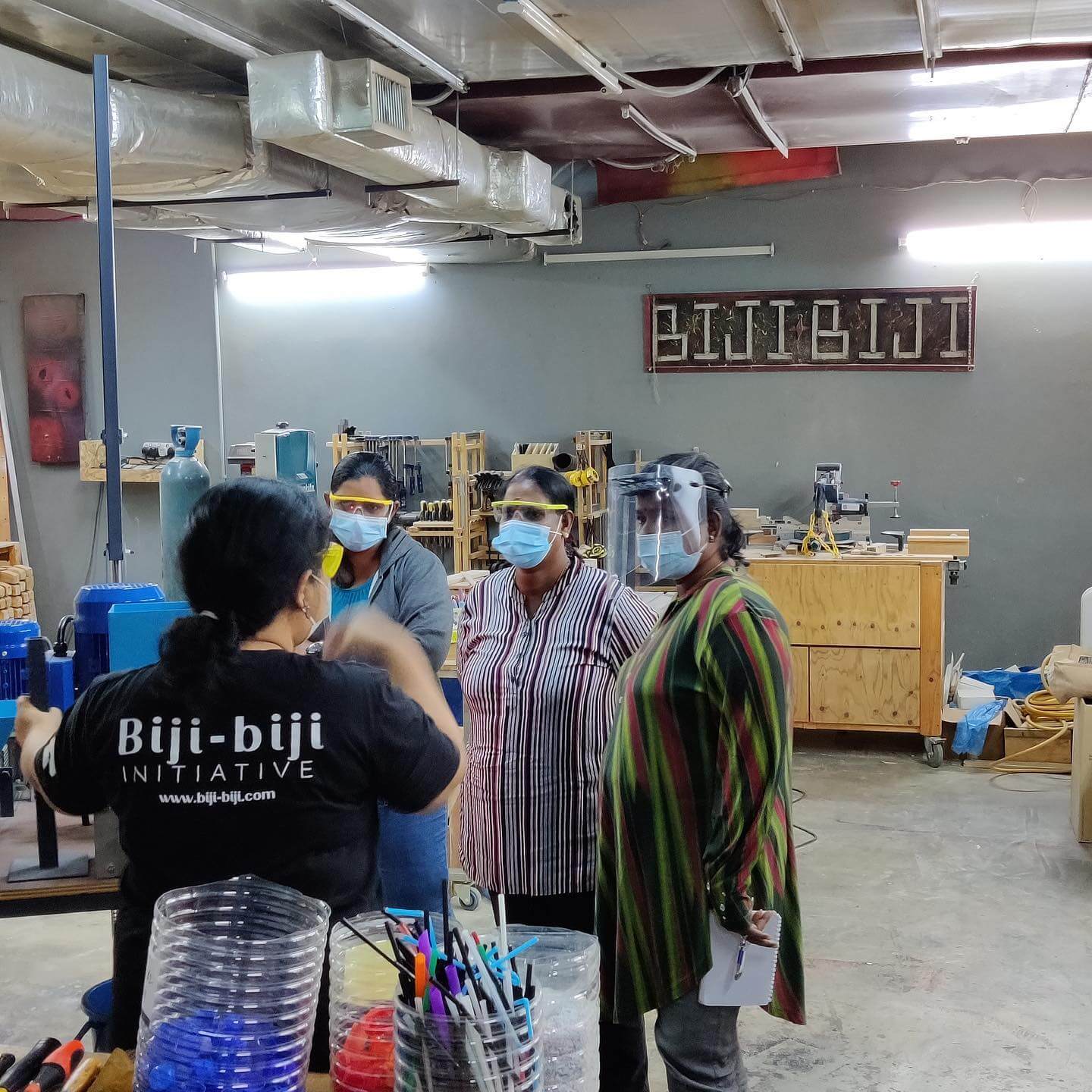 The fabrication team operates from a factory where all sorts of structures are built and designed from upcycled wood and metal. These structures are used at large events and in various spaces such as corporate headquarters and at markets.
Along with offering a wide range of paid-for products and services, the enterprise is also able to provide young creatives with the space, tools, materials and support to develop their ideas into something tangible and sustainable.
An estimated 20-30% of the enterprise’s income is ploughed back into Biji-Biji to add tools and machinery to the workshops. Funds are also used to invest in entrepreneurial ventures through their Intrapreneurship pool for research and development. This pool of reinvested funding is available to anyone on the Biji-Biji team to support the development of their creative and sustainable ideas.
Challenges and Overcoming Them
One of biggest challenges for Biji-Biji has been managing cash-flow with regards to bigger corporate orders, as well as the management of the enterprise’s scale and growth. The group has grown from a team of 4 people to a team of 40 forty people in just 5 years. Delayed payment terms from big corporates and a growing wage bill remains a challenge for the enterprise. To solve this, Biji-Biji leaders shared these challenges transparently with the rest of the team to get their buy-in in minimizing the challenges. Biji-Biji practices a very strong code of open-book finance with the entire team. As a collective, the team came up with the following solutions to address challenges:
- Delaying salaries and taking temporary pay-cuts
- Borrowing money from close relatives and friends
- Following up with previous clients that owe the enterprise funds
- The enterprise also adopted a profit-sharing mechanism with the entire team, allowing a fixed percentage of profits to be channelled back to the team. This creates a ‘we-are-all-in-this-together’ mentality.
Celebrating Success
Although Biji-Biji’s rapid growth has brought some challenges with it, it has also revealed great success for the enterprise. A team of 40 people with various skill-sets, strengths and weaknesses has grown Biji-Biji into a well-rounded and diverse team. As a collaborative initiative, the team is the enterprise’s greatest success factor.
Securing corporate clients has been a game-changing success point for the team. Corporate clients not only generate large incomes, but also enhance advocacy efforts around sustainability through a wider audience reach.
Social Impact
Three communities are currently involved in Biji-biji’s creative projects and initiatives. Thus far the enterprise has reached a minimum of 5000 people through their campaigns, talks and workshops. Six of Biji-Biji’s creative designs have been published on their open-source platform, while six new innovations have been explored and developed in the enterprise’s workshops.
A total of 90.56% of Biji-Biji’s materials are procured locally. Biji-Biji is proud that at least 630 meters of seat belts, 78 units of diesel drums, 4521 units of pallet wood, 551 kilograms of banners and 2610 kilograms of metal have avoided landfills through their upcycling projects.